enjoy the rain

28 Dec

Whatever can go wrong will go wrong, at the worst possible time and in the worst possible way. ~ Murphy’s Law
combustion*

Moments after receiving my very first really big illustration assignment — a semi-rush job — the phone rang again. This time, it was the supervisor of my (despised) day job calling to tell me to pack my bags, I was being flown to Baltimore for the weekend. The spread I’d just been assigned was due on Monday. But now, rather than happily spending the weekend in my cozy studio painting my first big splashy professional spread, I was going to be sitting in coach en route to Baltimore, where I had to work a silly trade show. Why, Universe? Why, why, why, why, WHY?!!!

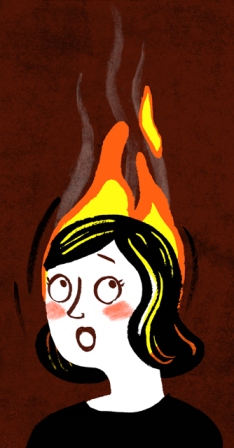
My brain spontaneously combusted on the spot.

I packed my paint pots and my sour attitude and hit the road, completing the assignment in the wee hours at the Baltimore Hampton Inn. Did I make the deadline? Yes. Did the art look great? Well… yes! Did I enjoy the experience?

What kind of question is that? Of course I did not enjoy the experience. I should have been able to enjoy it, but Fate stepped in to make sure that I would be miserable instead. I was stressed beyond belief, and exhausted. If memory serves, I caught a really nasty cold on the plane coming home, so I had an irritating two-week reminder of the whole awful experience. Thanks a lot, Universe.

That was seventeen years ago.

Since then, Universe has not stopped trying to thwart my efforts to make my deadlines. All manner of interferences have cropped up. Exploding hard drives. Feverish children. Hurricanes. (Did you know, when you live on an island, you and everyone else on yours and all surrounding islands — and all residents of the state of Florida, to your south — are forced, at the mere threat of a hurricane, to evacuate, all at the same time, on the same highway? Even when you are racing against an impossible deadline, making art for a 32-page picture book out of cut tissue paper. Oh, yes.)

rain*

Last summer, while I was in the middle of a pressing four-book deadline, my family decided to move! On Life’s List of Traumatic Experiences, moving is number two, just below death of a spouse. It’s a big deal.

Did I make the deadline? Yes. Did the art look great? Youbethcha.

Here’s the million dollar question: Did I enjoy the experience?

Quite a bit, actually. It was tumultuous, but fun.

It’s taken almost two decades, Class, but I have finally accepted the fact that the world will never be a perfect place. Trouble waits around every corner. Here’s the trick: refuse to let it bother you.

It’s not sunny all of the time, so buy an umbrella that’s so cute you can’t wait to use it, and some adorable water-proof boots. Either that, or learn to enjoy getting wet.

One handful of peaceful response is better than two fistfuls of worried work.  Ecclesiastes 4:6, The Message (Eugene Peterson)
diamond v glass {opinions}

15 Dec

diamond*

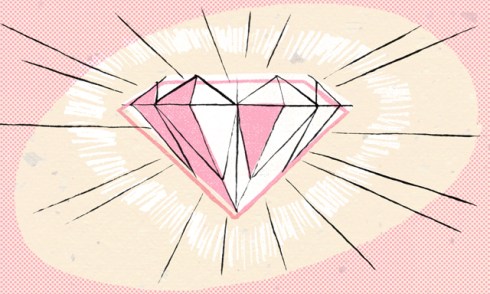
Asking questions is a good habit, and it’s easy to do. The real work begins once you’ve gathered a bunch of answers. Sorting advice is tough, like distinguishing diamonds from clear Swarovski crystals. Everyone’s got an opinion, it seems, and often the opinions of people you respect conflict.

Students and new graduates struggle to weigh advice from their peers and professors, parents and professionals. I see it all of the time. Here are a few tips from your old Auntie Violet, to help ease your mind.

  • Only ask advice from people you respect. When choosing advisors, look for people who are doing, not just talking.
  • Especially in art, too many cooks spoil the stew. When you try to please everyone, you lose your edge, so stop trying to make everybody happy! Get comfortable with the fact that some people won’t like the decisions that you make. That’s just a normal part of life.
  • When opinions conflict, there are probably multiple legitimate options on the table. You can’t listen to all of them. Go with your gut.
  • When a variety of well-meaning people all give you the same advice, pay attention. Maybe you’ll still go the other way, but advice like that is worthy of consideration.
  • Making mistakes is a big part of the process, so don’t be stymied by indecision. Give yourself the grace to fail. And when you do, don’t beat yourself up. Nobody is right all of the time.
  • Always accept advice with appreciation and respect—even when you think it is terrible. The person who gave it is probably trying to help you, so be kind.
  • When ASKED for advice, take care with your response. Your words matter, a lot. They really do.

Here’s the crazy thing about advice: In the end, nobody can tell you what to do, because no one else IS  you! What worked for someone else (different personality, different circumstances) may not work in your case at all. Wisdom is earned, you have to fight to get it, and you’ll get a little scraped up along the way—so make sure to include some compassionate, Band-Aid carrying friends in your board room full of advisors.

I owe my success to having listened respectfully to the very best advice, and then going away and doing the exact opposite. ~ G. K. Chesterton


thank-FULL

21 Nov

When I was young, I free-lanced as a theater designer in NYC. My actor friends dreamed about landing roles in soap operas, because the work would be some kind of steady. The principle is the same in illustration: repeat business offers a glimmer of stability. Clients who offer regular work are the flying buttresses that hold up the cathedral of a successful free-lance career.

Regular jobs shape your portfolio, so the fit has to be good. Sometimes it isn’t. I had to walk away from one of the higher-profile jobs of my life (2 illos monthly for a prominent national magazine) because of artistic differences. Thankfully, all of my other experiences in this arena have been wonderful. Some of my repeat clients call every year or two, others much more often; no matter the frequency, I am grateful for each and every one.

I have illustrated an advice column for a nursing magazine for more than a decade (thank you, Lisa!), and am currently making covers for books 11, 12, 13 and 14 for my favorite publisher (fourteen books—thank you, Duopress!!). My friends at the Baltimore Sun (thank you, Jay!) have kept me busy semi-regularly for the past few years as well.

In future posts, Class, I’m happy to suggest ways to get and keep clients, but this is Thanksgiving!

Today I simply want to say, T H A N K   Y O U!

joy

14 Nov

“Whatever feeling, whatever state you have at the time of the stroke will register in the stroke.” ~ Robert Henri

Class, if you struggle in your work, we can usually tell. If you hate your topic, it shows. Love it, and we sense that, too.

Of course, illustrators don’t get to pick their paid assignments; that’s the nature of commercial art. Oh sure, when jobs are storming in it’s easy for an artist to turn down the ones she’d rather not do. I have often said no to illustration jobs—usually  because of an over-crowded schedule, but also, occasionally, because I didn’t believe in the content.

Alternately, sometimes jobs that seem wonderful can but turn out to be a headache. That can happen when the illustrator and art director end up having conflicting visions for the assignment or a basic personality conflict, or late breaking news changes the layout of the paper at the very last minute and the beautiful horizontal illo you’ve labored over for a day and a half is now vertical (seriously?!?) and you have an hour and ten minutes to make the change.

Anything can happen in the process of a paid job. You are hired to make the art, but your design decisions are trumped by those of art directors and editors. On the other hand, when you have time to make self-directed projects for your portfolio, you are in complete control. Use that freedom! Choose topics that make your heart sing, because you can! Create lots of what you do well, and of what you love to do. Sell your joy.

I made the above coffee shop image for fun years ago because I love coffee and coffee shops, and, at the time, I really enjoyed incorporating pattern into my work. My sweet friend Kim Rosen graciously offered a bit of art direction. (Future blog topics: collaboration / two heads are better than one / working with friends makes life fun.)

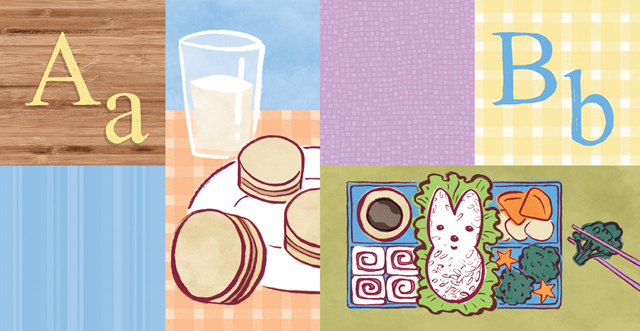
When I ask clients to send me samples from my website of the work they love and want me to emulate in the jobs for which they are hiring me, more than any other image, they send me the coffee shop. I’ve gotten a ton of work from this one image, including My Foodie ABC, the first of more than ten books I have now illustrated for Duopress.

Several years ago at a college illustration conference, Yuko Shimizu told us how clients began asking her to include elements from her personal work into paid assignments. A quick look at her amazing website shows this principle in action.

Use your personal work to develop as an artist, but also to attract work that you will enjoy doing. In other words, don’t make business art if you’d rather draw dinosaurs. As my friend Jillian‘s dad (Jimbo) likes to say, Do what you love, and you’ll always love what you do. We sense your joy in creating; use that pervasive sense of joy to your advantage.

Joy is highly attractive.

Darren & Jane

7 Nov

If you’re serious about pursuing a career in illustration, you’ve done your research. You know there are plenty of paid portfolio sites out there, and agencies, too.

Portfolio sites generate income for the people who run them. They are selective but are generally happy to take on new illustrators, because in so doing they make a profit. In exchange for an upfront or pay-as-you-go fee, they will display your work among many other portfolios, all under one roof. The result: one-stop shopping for art buyers. Most illustrators participate in at least one paid portfolio site. It’s a normal part of promotion.

Agencies are an entirely different matter. An agent represents the members of her group, handling contract negotiation and the bulk of promotion, for a percentage of any and all assignments that roll in as a result. Signing with an agent is the beginning of a business partnership. It’s almost like getting married.

Generally, it is far easier to participate on a paid portfolio site than it is to sign with an agent.

This is where Darren and Jane come in.

Class, meet Darren Di Lieto, creator of The Little Chimp Society and Hire an Illustrator!. Darren (who never sleeps, apparently) is also Anna Goodson‘s webmaster, which is where I met him. While repped by AGM for ten wonderful years, I sent desperate e-mail messages to Darren asking, for the bajillionth time, How do I log in again? and Why isn’t my image loading properly?

Despite this, somehow or other, Darren and I are friends—a fact of which I am very proud. Darren and wife Jane love illustration and illustrators, and have for the most part devoted their lives to furthering our cause.

The Little Chimp Society is a free illustration news portal. If you are not participating, you should! Creating a new piece of art for your website constitutes as news, so don’t be intimidated. Submit your story, and watch your site stats jump as a result.

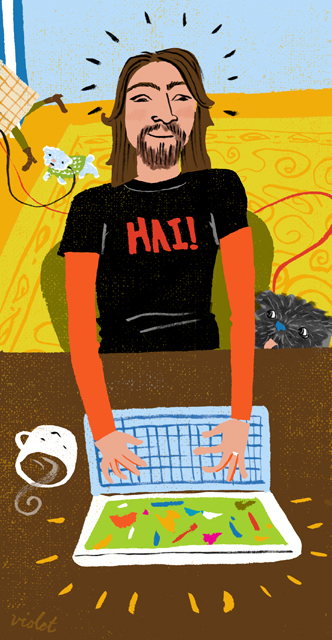
Hire an Illustrator is sort of an anomaly in the realm of illustration portfolio websites. Like so many others— The Alternative PickDirectory of Illustration, IllustrationMundo and etc.—it is a paid portfolio site. HAI’s rates are manageable, even when you’re first starting out, which is great. But here’s the kicker: Darren and Jane offer the added benefit of sending out postcard packs to a list of clients—a perk usually provided by an agency, not a portfolio site. HAI will even handle the printing of the card for you. And, unlike an agency, HAI does not take a percentage of any work generated by direct mail.

In short, Class, we owe Darren and Jane a mighty, collective THANK YOU! Check out HAI and the LCS, and tell them Violet sent ya.

__________

Dear Jane: Thanks for your every edit to the posts I submit to the LCS, and for your patience and kindness over at HAI. As I have never seen your lovely face, I thought it best not to attempt a likeness in the above illustration. But oh, I know you are there. We all do.

sidestepping obstacles

31 Oct

Build upon strengths, and weaknesses will gradually take care of themselves. ~ Joyce C. Lock

Illustration is a tough business. Super-duper. When I teach illustrators who are about to graduate and face the real world — students who have had years to explore, practice, and hone a style — I ask them to assess their portfolios, and list their personal strengths and weaknesses.

Everybody excels here and struggles there, but not everyone is equally self-aware. Self-awareness is a sign of maturity. In a tough marketplace, it is essential for survival.

When you are honest about your strengths and weaknesses as an artist, you can become your best self.

Life coaches and business experts often instruct us to identify our weaknesses so that we can strengthen them. I prefer to spend time strengthening my strengths. It’s not that I’m lazy. It’s just that I know who I am, and who I am not.

We are creative people, Class. Let’s find clever ways around our personal obstacles.

I’ve already confessed my lack of skill when it comes to color. The easy way around this obstacle is to use existing palettes created by people whose color sense is better than my own. When I use a proven palette, there is no struggle evident in my work. I learn as I go, and make fewer lackluster illustrations in the process.

Nathalie Dion told a similar story to my class via Skype several years ago; she has kindly given permission for me to retell it here.

When she was a student, Nathalie struggled with perspective drawing. As a result she all but eliminated perspective from her artwork, a decision that impacted her style in a profound way. Mme Dion found a path around her obstacle, a decision which went on to pay big dividends.

In both cases — my struggle with color and Nathalie’s, with perspective — we imposed style rules on our work. When I add color to a drawing, I force myself to stay within the palette I have chosen. This can be challenging, but the results are exciting, because the limitation forces me to make choices that wouldn’t even occur to me otherwise. The same is true for my sweet friend Nathalie, whose self-imposed challenge forces her to find interesting and clever ways to suggest depth, with limited use of perspective.

Know your weak areas and use them for good. Some obstacles are put in your way to make the path you travel more interesting.

__________

The Big Breakup (above), by Nathalie Dion. Nathalie is represented by Anna Goodson Management, Inc. See her entire portfolio on Anna’s site by clicking here.

{ l e g a l } THIEVING

23 Oct

“Of course, I subscribe to Graphis, Communication Arts and Print, and whenever I see something I like, I steal with both hands.” ~ David Lance Goines, 1992 (from a personal letter)

As visual people, we can’t help but be influenced by the art and design that we love. If you want to be a successful illustrator with a lasting career, you have to stay on top of color and style trends, and adapt as the culture’s taste changes. Artists are always learning, always growing, and are always influenced by their environment. Therefore, we had better monitor the environments in which we put ourselves!

Some of us have to be more careful about this than others, because we are like tofu.

Tofu  has no inherent flavor; rather, it takes on the flavors of the other ingredients in the recipe. Throw in some curry, and the tofu tastes like curry; saute tofu with bell pepper, and it tastes like bell pepper.

Many art students are like tofu simply because they haven’t had time to develop yet, artistically. If you suspect you may be the tofu-type, my advice is to stop looking at other illustrators for inspiration. Assailing your brain non-stop with illustration can be confusing, and can even cause unintentional plagiarism.

Instead, look at fine art and graphic design. Spend an afternoon at the botanical garden, or flipping through the latest issue of Elle Decor. Steal a color palette from a pair of designer high-tops, or a roll of wrapping paper. Be influenced by good design, without bombarding yourself with images made by your illustration heroes.

This will help your work improve as you become uniquely you.

I stole the color palette from the crazy shower curtain in our upstairs bathroom (see photo above) for this holiday image. Many artists struggle with color, and I am no different. I have learned not to trust myself when it comes to color. As a rule, I always “steal” an existing palette designed by a professional colorist. It’s a good trick, and falls under the heading of LEGAL THIEVING.

voice

15 Oct


… and the truth of your experience can only come through in your own voice. If it is wrapped in someone else’s voice, we readers will feel suspicious, as if you are dressed up in someone else’s clothes. ~ Anne Lamott, Bird by Bird: Some Instructions on Writing and Life, p. 199

Writers talk a lot about finding their voice; we illustrators use the term STYLE, but it’s all the same, really.

Each of us has a unique speaking voice. We can’t help it; it’s in our DNA. The problem is, while other people love and appreciate our voices, we often do not. For me, this could not be more true. My voice may be the sweetest sound on earth to my son, but when I hear the outgoing message on my phone, my blood runs cold.

The same principle applies to the art we make, doesn’t it? Many of us — dare I say, most — are hard on ourselves. We pine over the work of our peers, and by contrast we feel our work is lacking. Why should I even bother? Look at her awesome portfolio! I may as well go dig a hole in the backyard and jump in. Sound familiar? Trust me. Even those of us who have achieved a certain level of success suffer bouts of self-doubt.

Quite regularly.

We really do.

Now, Class. While it is true that there is always room for improvement, we need to remember that each of us has a unique voice. And that’s a good thing. So… shout, sing, chat it up! Earth is big enough to accommodate every voice, every portfolio, every style. Appreciate the art that other people make, rather than using it as a measuring stick with which to whack yourself over the head. (Age helps with this, by the way. Take it from old Auntie Violet, whose skull is scarred from decades of self-inflicted lumps.)

Learn from other voices, but meanwhile, get comfortable being you.

Style is what happens when you stop trying. ~ James McMullan

boost

12 Oct

The student is not an isolated force. He belongs to a great brotherhood, bears great kinship to his kind. He takes and he gives. He benefits by taking and he benefits by giving. ~ Robert Henri, The Art Spirit (pp. 18-19)

*

When teaching self-promotion I cover all of the expected topics — advertising, social media, networking, etc. — most of which I will write about in subsequent posts on this blog. There is a secret spring that runs beneath the surface of Self-Promo Land, however; a spring that ties them all together, and feeds each and every promotional effort. The spring is called GENEROSITY.

Yes, you should give stuff away to potential clients: pens, magnets, all of that. But generosity at its best goes deeper, affecting not only your relationships with clients, but also with your fellow illustrators.

Give the gift of promo.

Don’t promote yourself exclusively. Promote other people, too. Maybe they will do the same for you in return, but if they don’t, that’s okay. By definition, a true gift is freely given.

Nobody likes the guy who walks around in the light of his own personal spotlight all of the time. That guy is intolerable, an annoying gnat. But, think about it: everybody likes the guy who offers light to others.

Now, Class. I know some of you are thrilled to hear me say this because you are quiet little mice who prefer the cool comfort of the holes in which you live, and the thought of promoting yourself makes your blood run cold. Most illustrators I know, including Yours Truly, are introverts. To you, my fellow mice, I say this: You still have to make some noise and tell the world that you exist. Squeak! Speak up! No one knows better than you, what you do, and the services you are willing to provide to your fellow man. Don’t expect other people to do this for you. I send out postcards and advertise on various websites and use social media to promote myself directly (future posts!), but I also use those tools — the free ones — to promote my friends. Because I want the best for them. I need to make a living, but I want them to succeed, too.

We are all competitive — a good thing — but let’s face it, visual artists rival writers when it comes to being neurotic. And we all know what a mess they are (she wrote, tongue in cheek). We are convinced that everyone else’s career is going better than ours. Each of us is on a separate path, but the terrain under everyone’s feet is hilly. Every artist spends time in the valley, as well as on top of the mountain. Yes, for the past eight years or so work has been more scarce than it used to be, but that’s all the more reason to celebrate when any of us lands a new assignment.

Be a generous promoter, and celebrate your friends’ successes. Your career and your life will be better for it.

It is really not important whether one’s vision is as great as that of another. It is a personal question as to whether one shall live in and deal with his greatest moments of happiness. ~ Robert Henri, The Art Spirit (p. 32)

sketchbook

9 Oct

*

The sketch hunter has delightful days of drifting about among people, in and out of the city, going anywhere, everywhere, stopping as long as he likes—no need to reach any point, moving in any direction following the call of interests. He moves through life as he finds it, not passing negligently the things he loves, but stopping to know them, and to note them down in the shorthand of his sketchbook, a box of oils with a few small panels, the fit of his pocket, or on his drawing pad… He is looking for what he loves, he tries to capture it. It’s found anywhere, everywhere. Those who are not hunters do not see these things. The hunter is learning to see and to understand—to enjoy.

~ Robert Henri, The Art Spirit (p. 17)

*

Do you keep a sketch book?

True confession: I don’t. I never have. (And the earth shook ever-so-slightly as Robert Henri* rolled over in his grave.)

It’s not for lack of Sketch Respect, or for a lack of trying. I have bought dozens of sketch books over the years: little ones to carry, and big ones as an organized source of paper. The big ones are filled from cover to cover with process work for illustration projects, which doesn’t count. (I stopped buying them decades ago anyway, in deference to good old printer paper, which I recycle.) And the little ones? Sadly, a tiny army of them has been taking up space on my bookshelf for almost twenty years. If my son hadn’t doodled in them when he was four and five, they’d be all but empty.

Now wait just a ding dong minute. Artists are supposed to carry handy little sketchbooks, right? Robert Henri said so. Every art prof I ever had, said so. We’re supposed to be armed with pencil and pad, ready to record inspiration the moment it hits. We are not allowed to pack a suitcase without including a tiny watercolor kit and a baggie full of charcoal, because we are visual ninjas, and as such, we must be prepared.

Now that I am an old lady, Class, I have something to tell you about sketchbooks: There are obvious benefits to carrying them, if you use them. And. You can succeed in life, if you don’t. So let go of the guilt. (Guilt is even heavier than that empty sketchbook you’ve been toting in your bag.) Non-Sketchbook Artitsts do exist, and we are a happy and well-adjusted people.

*

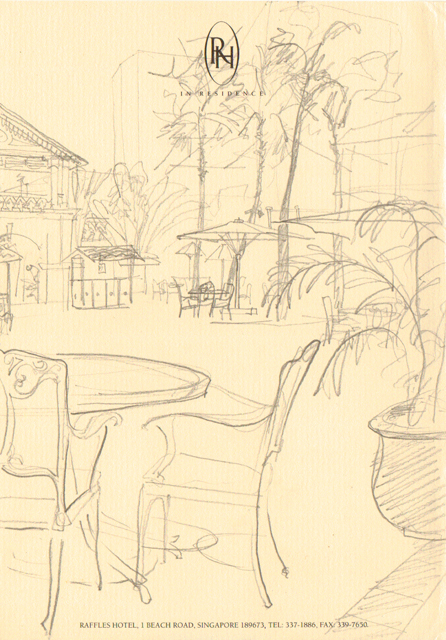
My scant collection of inspirations captured on napkins, receipts, and hotel stationery fits unobtrusively in a slender file folder.

__________

* American painter Robert Henri (1865 – 1929) taught at the Art Students League in the early 1900s. He wrote The Art Spirit—a must read—at the insistence of his students. My first year teaching, I began every class with a Robert Henry “quote of the day.” Now, I tweet him. Class, meet Robert. You’re welcome.

__________

How about you? What are your sketch habits?