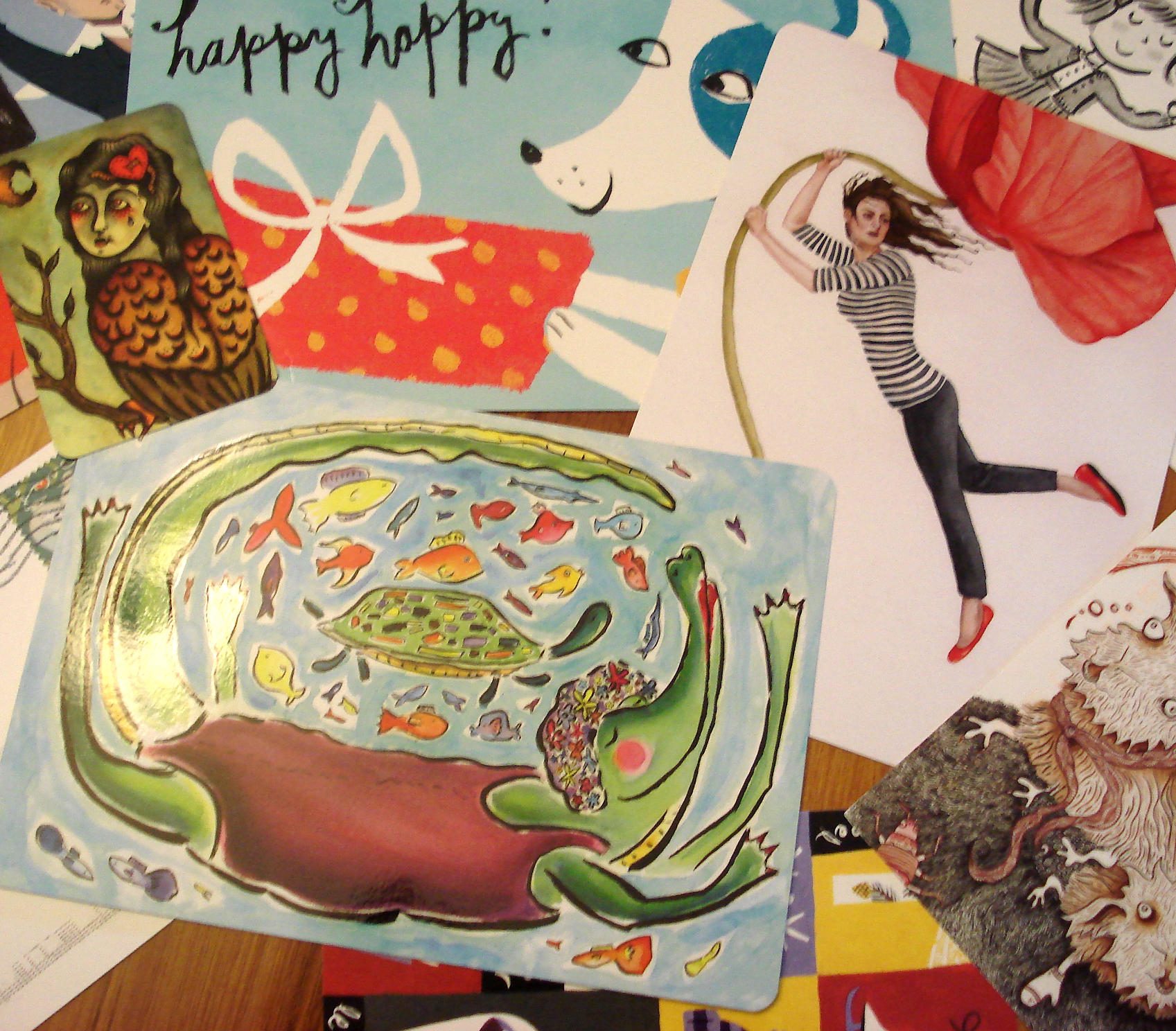
Free Time

5 Oct

All we have to do is decided what to do with the time that is given us. ~ J. R. R. Tolkien

When I was in grad school, Professor Dick Krepel told us that out in the real world there would be time to fill between jobs. “That’s when you clean your studio,” he said. “You know it’s messy. When else are you people going to clean up?”

He was right, of course. (Dick was right about everything.) Recently, having finished a barrage of book assignments, I took his advice. A few hours later, sitting in the middle of my pristine studio I wondered, “What next?”

There are a multitude of tasks that need to be handled between professional illustration assignments:  receipts need filing, portfolio sites need updating, and that unfinished book dummy calls from the shelf, “Pay attention to me!” What to do first? What is most important?

Obviously if there is no paid work to be done, attracting a NEW assignment is Priority One. For me, this process begins by making new work for my website. I use printing guidelines from a favorite print shop so that I can turn one of my new illustrations into a mailer. When completing the order I generally choose the slowest possible shipping option—to save money, and to buy a little time. Because time is always in short supply.

While waiting for the cards to arrive, I update my website and my mailing list, a combined task which, for me, takes a couple of weeks. Seriously. If I rush, I make mistakes. Putting sub-par work on my site, or mis-labeling postcards (or, sending cards to clients who would most likely not be interested in my work) are mistakes that could hurt my pocketbook and ultimately my career. Evelyn Underhill wrote, “Hurry and impatience are sure marks of the amateur.” She wasn’t kidding.

When the postcards finally arrive from the printer, labeling and stamping them usually takes me a day or two. The drive to the post office with the completed batch is pretty exciting. The way I see it, once the cards hit the mail box, the whole thing is in God’s hands.

Meanwhile, back in the studio while I wait for the phone to ring, I spend my days making more new work, promoting it via Twitter and facebook, and organizing those dreaded receipts. And yes, I tidy up. Again.

Free time? Who has free time?
Printing Promotional Materials

1 Oct

In my self-promo classes we talk a lot about where to have mailers and other promotional materials printed.

I recommend Vistaprint to my students because generally they are on a tight budget, and VP prints stuff for “free” (plus upload fees, and you pay extra for UV gloss coating and shipping).

There are two tricks to getting the biggest bang for your buck at Vistaprint:

1. Look around for their special offers and promo codes. When you place your first order, join their e-mail list. You will get several offers via e-mail every week.

2. Order multiple products all at once, so you only have to pay shipping one time.

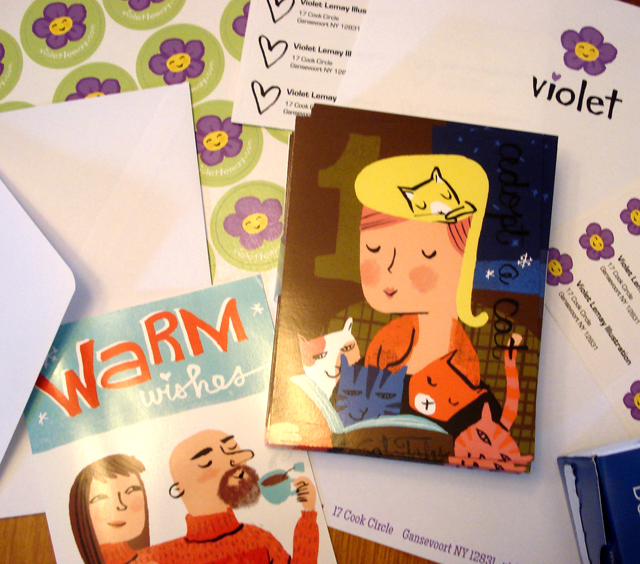
The photo above shows one of my recent Vistaprint orders: a hundred postcards, ten folded holiday cards (with envelopes), ten sheets of letterhead, a sheet of stickers, two styles of return address labels, AND  two hundred and fifty business cards—all for around $60. Everything looks fantastic. I designed each piece using VP’s product  templates, which are available for download (click “Artwork Specifications” under the title “Support,” at the bottom of the home page). My only complaint: I think the holiday card template is inaccurate. Beware, there.

Ninety percent of my students who use Vistaprint are happy with the results. There have been a few mis-cut business cards and off-color postcards over the years, but I guess that’s to be expected every so often from any print shop.

Moo is also excellent, if you don’t mind spending a little more. Unlike VP, they offer free color printing on the back. And at Moo, you can get business cards with rounded corners. Very nice. Read more about Moo mini cards on my blog.

At Overnite Prints, you can get free spot gloss—awesome! And many of my students love GotPrint; this one offers special shapes, for those of you who simply can’t be put in a box.

In the end, the prices and quality are all competitive. A wise illustrator will get to know all of the products offered by her favorite printer, and will use them to promote herself in various ways.

And class, don’t forget: No matter the quality of the print, it’s the quality of the imagery that matters most.

Moo business card by Lacey Eberle (upper left); Postcards, from bottom left to upper right: Molly Wilson and Joanna Gorham (GotPrint spot gloss); Katrina Kopeloff‘s card (VistaPrint) is cut off at the lower right.


The Components of Style

26 Sep

There are many facets to the gem that is an ILLUSTRATION STYLE. An illustrator is known by his or her typical palette, compositional tendencies, and concepting habits. (Does she tend toward change of scale, or is she more of an anthropomorphism kind of girl?) Primarily, however, the way an illustrator draws and the materials she uses define her style.

Is it possible for one portfolio to contain works created in a variety of media? Your professors will probably tell you, “No.” End of story. My personal experience, however, supports a different answer.

The way an illustrator DRAWS seems to transcend CHOICE OF MEDIA. Gary Taxali is Gary Taxali, whether he’s printing on an old leather book cover or painting oils on masonite.

I’ve changed my  technique several times during my career. During those transitional phases, after getting a sketch approved I sent samples of older work done in technique ‘A’ along with newer ones in technique ‘B’. “Which do you prefer?” I asked. More often than not my A.D. would send back a handful from each category with a brief note: “I like these.” As if — get this — the medium in which I chose to work didn’t matter. Sometimes I wondered, Can he even tell a difference?

What matters, class, is that you concoct super smart ideas and execute them well. Hone your drawing style and keep it consistent; then you can paint every once in a while—or stitch a needlepoint, like Helen Dardik—instead of clicking away on your laptop every day for the rest of your professional lives.

*